
One of the most common panicked questions I receive from grieving families is, “They didn’t leave a Will, who gets the house?”
There is a widespread misconception that if you die without a Will, your estate automatically goes to your oldest child, or that the State will immediately seize your property. Neither of these is entirely true, but the reality is equally rigid.
When you die without a valid Will in Trinidad and Tobago, you are said to have died “intestate.” When this happens, you completely lose a say in how your assets are distributed. Instead, your estate is divided according to a strict legal formula governed by the legislation of Trinidad and Tobago.

Here is exactly how the law decides who gets what.
The Strict Hierarchy of Estate Distribution as Per the Intestacy Law of Trinidad and Tobago
The laws of intestacy operate on a strict hierarchy of next-of-kin. The court does not care about your personal relationships, who your favorite child was, or who actually took care of you in your final years. The distribution is purely biological and legal.
Here is how the estate is divided in the most common family structures:
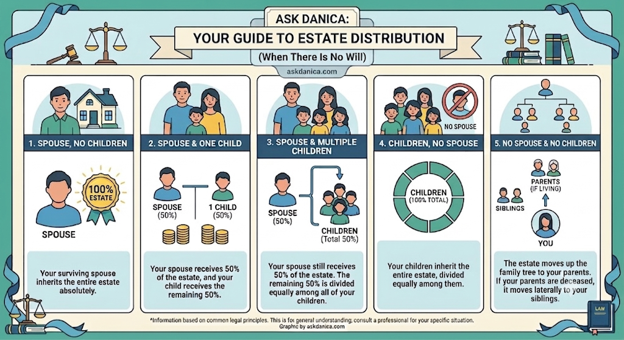
- You leave a spouse, but no children: Your surviving spouse inherits the entire estate absolutely.
- You leave a spouse and one child: Your spouse receives 50% of the estate, and your child receives the remaining 50%.
- You leave a spouse and multiple children: Your spouse still receives 50% of the estate. The remaining 50% is divided equally among all of your children.
- You leave children, but no spouse: Your children inherit the entire estate, divided equally among them.
- You leave no spouse and no children: The estate moves up the family tree to your parents. If your parents are deceased, it moves laterally to your siblings.
Only in the rare event that absolutely no blood relatives can be found does the estate pass to the State as bona vacantia (vacant goods).
Dying Without a Will: The Administrative Burden
Beyond who gets what, dying without a Will creates a massive administrative headache for the people you leave behind.
Because you did not name an Executor in a Will, someone must apply to the High Court for a Grant of Letters of Administration. This grant is usually issued to the person with the highest priority to the estate (typically the spouse or adult children). However, unlike an Executor who can take immediate steps to secure assets, an Administrator has no legal authority to deal with the estate until the court officially issues the grant.
Learn more about probate and other types of Grants of Representation in Trinidad and Tobago.
During this waiting period, which can easily take months or even years, bank accounts are frozen, bills can pile up, and property cannot be legally transferred or sold.
The rules of intestacy are a one-size-fits-all legal fallback, and they rarely fit the nuance of modern families. If you want to ensure a specific child gets the family home, or if you want to leave money to a grandchild, a sibling, or a charity, you must draft a Will.
Get more information on what happens if someone dies Without a Will in Trinidad & Tobago?
Do not let the State dictate your family’s financial future.
Ready to take control of your estate? Click here to learn more about our Will Preparation services and book your consultation today.